
Fiscal Year 2024-2025
At a time when healthcare systems across Washington continue to navigate compounding crises and the growing demands for support, the Northwest Healthcare Response Network (Network) remained a trusted leader and convener – connecting healthcare organizations, public health, emergency management, and community partners to strengthen readiness and response statewide. The Network stands as a vital, unifying force, advancing critical preparedness initiatives, expanded training and coordination capabilities, and an assurance that when crisis strikes, our healthcare system is supported to stand ready protecting every community. Our work is only achieved through an outstanding team and the dedication, expertise and resources of the many members, partners, donors and funders whose collaboration and commitment make this collective strength possible.
Thank you to our Sustaining Members and funding partners for their financial support during the last year: Columbia Bank, MultiCare, EvergreenHealth, Kaiser Permanente, UW Medicine, Virginia Mason Franciscan Health, Overlake Medical Center, Seattle Children’s Hospital, Bloodworks Northwest, Proliance Surgeons, Surgery Center of Silverdale, Aesthetic Eye Associates, Washington State Department of Health, U.S. Department of Health and Human Services Administration for Strategic Preparedness and Response (ASPR).
We look with optimism to the year ahead, working with you and our colleagues across the state.
NWHRN Board Chair
Executive Director NWHRN
Over the past year, the Northwest Healthcare Response Network (the Network) has continued to evolve as the backbone of Washington’s healthcare preparedness and emergency response. We build resilience in order to safeguard both the health of Washington’s people and the strength of its economy. A strong economy and a healthy community are inseparable; one cannot thrive without the other. The Network has concluded our first full year operating under our expanded statewide footprint, bringing new partners, new geographies, and new capabilities into alignment to ensure a more coordinated and resilient system of care. We now serve healthcare and local partners across 90% of Washington communities, supporting 34 of Washington’s 39 counties. Our ability to deliver on our promise—ensuring that care continues for all—has never been more visible, nor more essential.
Amidst a dynamic federal funding landscape and shifting preparedness priorities nationally and across our state, we have leaned into advocacy, leveraged our expertise, continued to build partnerships, and bridged critical gaps in system coordination, while delivering tangible results across Washington.
It was just July 2024, that the Network formally launched our statewide expansion—extending our coalition to include previously uncovered counties and communities in Central and Eastern Washington. This expansion, now complete, represents more than a geographical milestone. It reflects a force multiplier in building greater resilience, by bringing healthcare, public health, emergency medical services and emergency management partners together, building trust, sharing expertise, creating common protocols, and ensuring that capabilities aren’t confined to metropolitan hubs.
From tabletop exercises and hazard vulnerability analyses to real-time response support and pre-event messaging, we’ve worked to ensure that rural and urban systems alike have the tools, relationships, and clarity needed to meet future emergencies head-on so that patients get the care they need.
Our team and programs continue to engage, collaborate and incorporate the insights of partners across the state. Examples of our program engagement include the following:
National
Regional
The Network has emerged as a leading voice in the advocacy for sustained, robust federal investment in hospital and healthcare preparedness. With Congress poised to finalize appropriations and the future of HPP funding uncertain, our team has proactively engaged with partners and policymakers to share the real-life stories and operational value of the program. The Fall 2025 timeframe is especially critical for Congressional decision-making, and we are working to ensure that the Network’s contributions—and the risks to the healthcare system should funding lapse—are clearly communicated.
By helping translate response coordination into strategic national priorities, the Network continues to affirm the essential role of coalition-based preparedness and response capabilities in regional and national readiness.
Our work developing strategies to support the National Disaster Medical System (NDMS) has expanded, leveraging the tools and capabilities designed and built over more than a decade of collaboration and planning. Our engagement continues to increase and has resulted in a solidified national planning framework to stand up operational readiness in support of military partners and continued access to care for Washington communities.
The Network serves in a foundational role helping prepare our healthcare community for a surge in medical care and services, patient movement and transitions when needing to ensure patients receive care from the clinical teams and locations best enable to provide more specialized levels of care, and overall strategic readiness. We work to ensure that when hospitals reach capacity, patients can be safely and swiftly directed to available care. The Network’s work has positioned us as a national leader in this area, driving the advancement of operational capabilities.
Over the last year, we have deepened the partnerships and strategy that position the Network to most effectively support the interdependent relationship between the military services and the civilian healthcare system, while also bringing the operational solutions to advance the NDMS pilot work.
The Network continues to work with response partners to assess regional vulnerabilities and prepare for potential mass casualty incidents (MCIs). Providing expertise and resources for extensive planning through the HVA and tabletop exercises, focus includes active shooter, natural disasters, transportation-related crashes, among other incidents. The Network is uniquely positioned to respond to the unexpected in terms of healthcare response, patient tracking for family reunification. We are an integral part of state’s broader mass casualty response capabilities.
This year, our team worked with partners across the state to finalize development of a unified methodology for assessing hazard vulnerability across Washington’s healthcare landscape – the Hazard Vulnerability Analysis (HVA).
The Network partnered with Jensen Hughes to review the existing HVA process, identify areas of enhancement and deliver a final product more attuned to the healthcare partners we serve. This third-party review of the HVA process allowed us to strategically allocate resources and efforts, while validating the positive impact the of the HVA process and report.
Recognizing that risk is both shared and local, this strategic effort seeks to create a common framework for understanding healthcare vulnerabilities in ways that inform preparedness investments, resource planning, and partner alignment. The intent of the report is to enable healthcare organizations, public agencies, and regional coalitions to speak the same language when it comes to healthcare readiness.
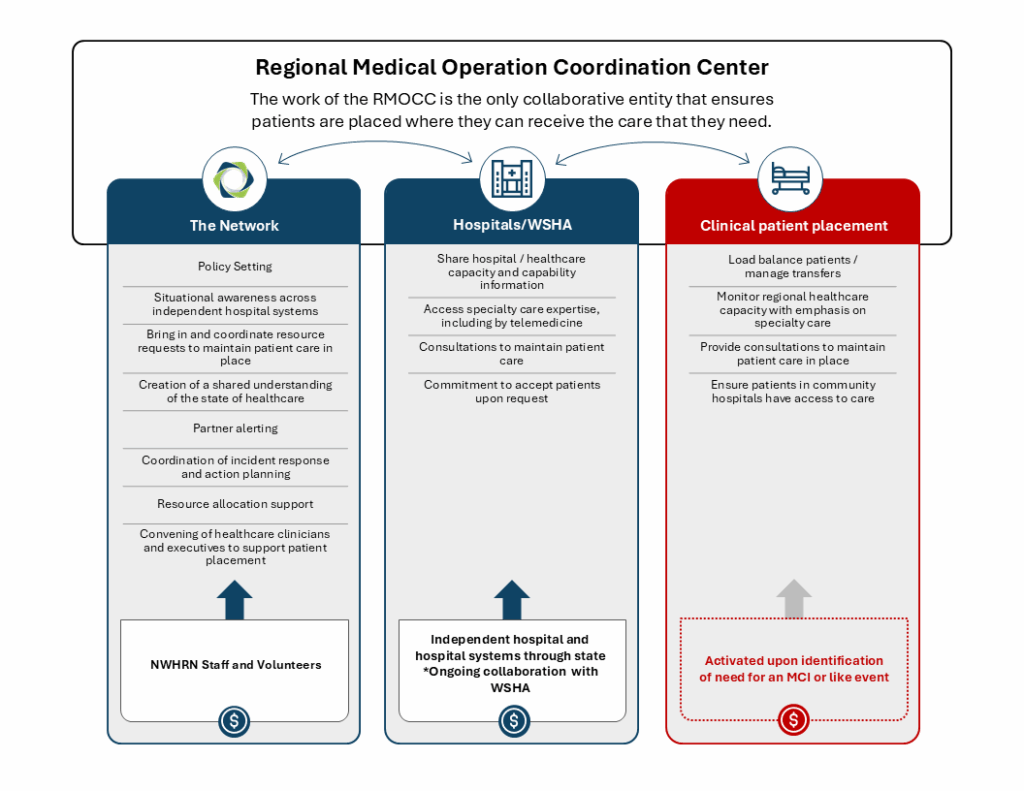
The conclusion of the 2024-2025 fiscal year saw the sunsetting of the Washington Medical Coordination Center (WMCC), at which time the Network stepped in to support several key elements of a critical void— helping to ensure that healthcare systems continued to have visibility into clinical capacity and shared coordination during emergencies. Through efforts including our weekly situational awareness meetings, capability tracking, and healthcare partner forums, we help define and sustain much of the work of the Regional and State Medical Operation Coordination Center (MOCC), while collaborating with partners to innovate in ways to meet community needs.
The Network is co-leading Washington State’s 2026 FIFA World Cup mass casualty incident (MCI) planning for state level engagement. Our leadership brings together expertise to align with county and city planning – for both effective deployment in times of crisis and with a view toward efficiency to avoid duplication of efforts.
Strategic partners include public health, EMS, statewide hospitals, and behavioral health providers, to develop a comprehensive action plan.
From establishing a common operating picture to refining patient tracking protocols, our work ensures that healthcare systems are ready for any potential scenario.

Since 2023, the Network has convened healthcare stakeholders in the development of a Health Care Working Masking Consensus Statement. This healthcare community-informed guidance is a result of infectious disease and public health leaders working together, as part of the Masking Workgroup, to develop evidence-based strategies to guide healthcare workers masking policies. The goal of this work was to mitigate transmission of respiratory disease in the healthcare setting during respiratory season and thereby protecting high-risk patients visiting clinics or are hospitalized. Updated guidance is being developed with partners for 2025.
Following hurricane damage to a Baxter facility in North Carolina, the Network played a pivotal role in alerting and supporting Washington hospitals to navigate a critical IV fluid shortage. By convening partners, developing conservation strategies, brokering resource sharing and ensuring continuous situational awareness, we helped mitigate the impact of this shortage—an example of how trusted relationships and real-time communication and coordination save lives.
Recognizing the gaps in pediatric healthcare access—especially in rural and vulnerable communities—we led efforts to train and equip non-specialty hospitals and EMS providers to deliver appropriate pediatric care during emergencies. From standardized protocols to simulation training, we are working to ensure that every child in crisis can access timely and appropriate care.
From fire evacuations in rural communities to earthquake readiness planning, our team supports long-term care facilities with customized planning, direct response assistance, and pre-event communication strategies. In 2025 the Network launched dedicated, quarterly information sessions to inform LTC partners of emerging and relevant issues directly impacting their services. Our proven experience and expertise include responding to the needs in Montesano, WA, when our team helped coordinate the emergency evacuation of nearly 90 skilled nursing residents during a local fire, demonstrating once again the value of being “always on” for the healthcare system’s most vulnerable.
As the Network enters its next chapter, we remain guided by a unified purpose: to ensure that healthcare systems in Washington are ready, resilient, and able to provide care to all—no matter the crisis. Through trusted partnerships, strategic foresight, and unwavering commitment, we will continue to serve as the backbone of healthcare preparedness in our state.
Together with our partners, we are not only responding to emergencies, but we are also shaping the future of healthcare resilience.
Citations
1.Climate Resiliency Report, The Preparedness Payoff, from the U.S. Chamber of Commerce, Allstate, and the U.S. Chamber of Commerce Foundation, 2024.
2.Association Between Caseload Surge and COVID-19 Survival in 588 U.S. Hospitals, March to August 2020, Kadri, Sun, et al, Annals of Internal Medicine, 2021.
3.NWHRN 2024-2025 All-Organizations Engagement Metrics.
We use cookies to improve your experience on our site. By using our site, you consent to cookies.
Manage your cookie preferences below:
Essential cookies enable basic functions and are necessary for the proper function of the website.